
Humanoid Robots are a job for 1,000 ton die casting machines, not a Giga Press job 🏭 or not yet…
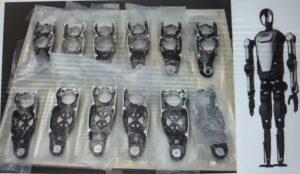
A typical humanoid robot has 40–56 degrees of freedom.
Each actuator and joint needs housings, gearbox cases, structural brackets and links.
Those parts are compact, ribbed, thin-walled, often with cooling fins.
That geometry runs on the machines most Western foundries already have.
The economics are straightforward:
-> Die casting makes near-net-shape complex parts in seconds-to-minutes, then CNC only the critical features
-> At the volumes these programs will eventually require, that beats full CNC on cost and throughput
-> It also beats additive on unit cost and properties once you leave prototypes
Small and mid-sized casters do not need 2,000+ ton presses for this work.
The installed <2,000 t base is already the right size for early high-volume humanoid hardware.
The open question is which foundries sit down with robot OEMs while the programs are still being defined.
Molds with many cavities which require clamping forces above 2,000 ton can make sense for exceptional high volume programs and standard part suppliers.
 Spanish
  English
  Chinese
  German
  French
  Polish
  Portuguese
  Japanese
  Vietnamese
  Thai
Thai  Russian
  Arabic
  Korean