
Additive manufacturing is one of the most powerful tools in modern engineering — but it should not become the default answer to every lightweighting problem.
For humanoid robotics, the key question is not:
“Can this part be 3D-printed?”
but:
“Which manufacturing route gives the best combination of properties, weight, production time, cost and scalability?”
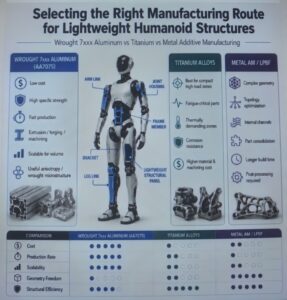
For many structural components, high-strength wrought 7xxx aluminum alloys such as AA7075 may offer a strong alternative to titanium or metal AM.
Extrusion, forging and machining can provide:
high specific strength + mature heat treatment + predictable anisotropy + repeatable properties + short cycle time + scalable production.
In some cases, anisotropy itself can become a design variable. Extrusion or forging direction can be aligned with dominant load paths rather than treated only as a limitation.
Compared with titanium, 7xxx aluminum can offer much lower material and machining cost while retaining excellent structural efficiency where temperature, corrosion or extreme local loading do not require titanium.
Compared with LPBF, conventional wrought processing can also offer a major advantage:
industrial throughput.
AA7075 remains difficult to process by LPBF because of hot cracking, Zn/Mg evaporation, porosity and composition shifts. Even successful approaches often require alloy modification, careful process-window development and post-processing.
For high-volume humanoid production, build time, support removal, heat treatment, surface finishing, inspection and quality assurance may become just as important as nominal material properties.
This does not mean AM is unnecessary.
AM is extremely valuable where geometric complexity, topology optimization, internal channels, part consolidation or local functional integration create measurable system-level value.
But using AM for a part that could be efficiently extruded, forged or machined may create a technologically advanced component — and an economically inferior product.
My view is therefore simple:
wrought 7xxx aluminum where structural efficiency and volume dominate;
titanium where its unique properties are truly required;
AM where geometric freedom justifies its cost and cycle time.
The goal is not to use the most advanced manufacturing technology.
The goal is to use the right technology in the right place.
Selected references:
Ficht & Behnke, Curr. Robot. Rep. 2 (2021) 201–210. DOI: 10.1007/s43154-021-00050-9
Recent progress in AM of 7xxx Al alloys, Int. J. Adv. Manuf. Technol. (2025). DOI: 10.1007/s00170-025-15415-z
Gan et al., Materials Characterization 235 (2026) 116304. DOI: 10.1016/j.matchar.2026.116304.
 Russian
  English
  Chinese
  German
  Spanish
  French
  Polish
  Portuguese
  Japanese
  Vietnamese
  Thai
Thai  Arabic
  Korean